


The range of film cameras available on eBay and specialist stories is huge - large format, medium format, SLRs, rangefinders, compact and not-so-compact. Here are a few things to know when buying your first analogue film camera.
Rangefinder cameras
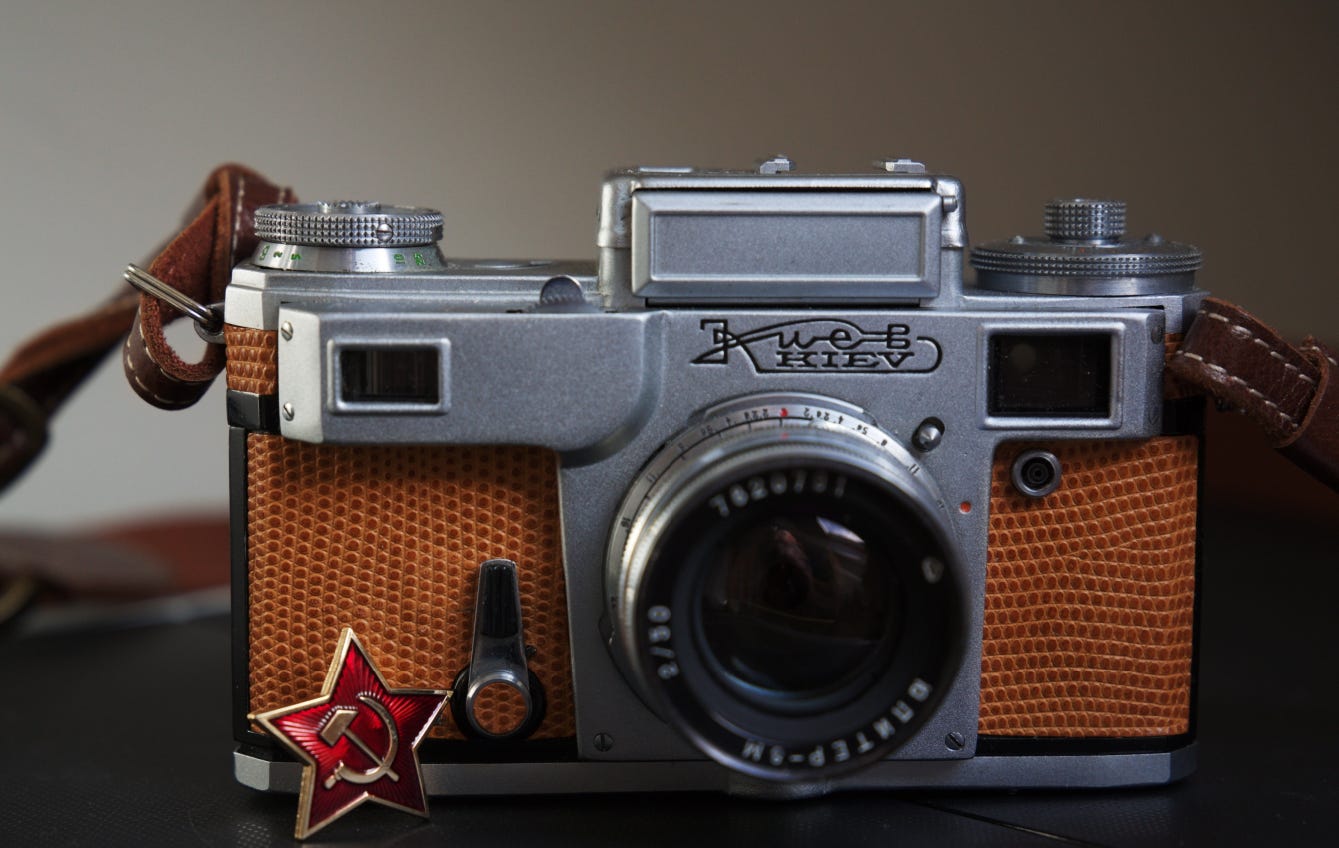
These were used by legendary war photographers like Robert Capa in the Second World War. They were the standard tool of photojournalism for at least 50 years and even today, you will often find their digital equivalent as a backup in the bag. These cameras were focused through a viewfinder and prism. You focus and compose through a window on the top right, just like on a disposable camera. The rangefinder looks out of the little window on the left. It triangulates as you turn the focus ring, bringing two images into correlation at perfect focus.
These cameras were very often European - like the expensive Leicas and Contaxes, or the Russian Kievs and Feds, after the war. My 1982 Kiev even today takes amazing pictures thanks to its excellent lens and fantastic metal body.
Increasingly, the Japanese dominated the rangefinder market in the 1950s and early 1960s and some fully automatic models emerged. These still take fantastic images.
A good quality rangefinder like the Kiev 4 will cost less than £100, or go for a more modern design like the excellent Olympus Trip for less than £50. There are also compact rangefinders like the beautiful Olympus XA from the early 1970s which have exquisite lenses and are about as compact as any modern sureshot type would be.
Rise of the SLR
SLRs (Single Lens Reflex) cameras use a different system. When you look through the viewfinder you see what the lens sees thanks to a prism and a mirror that allows you to see what the lens sees. Lenses can be changed to give you multiple options on what your photo looks like. These became the dominant design for professional photography after the launch of the Nikon F Series in 1959, which was the world’s first system camera - a camera that had a range of lenses, adapters and accessories designed to meet the needs of professional photographers.
While Japan dominated the market, there are excellent Russian examples of these SLR cameras like the Zenit which are a lot cheaper.
The Canon AE and AE-1 Program SLRs were made in their thousands from the mid 1970s and are still relatively cheap - coming in at £100-200 depending on condition and lenses supplied. These were semi-professional models that still give excellent results.
For something more compact, and a true professional SLR, Olympus equivalents of the time are still great value. My own OM1 is not only my SLR of choice but is borderline work of art - look at its lines, the build quality, style and compact nature. It looks like it just came out of the factory even though it is at least 43 years old.
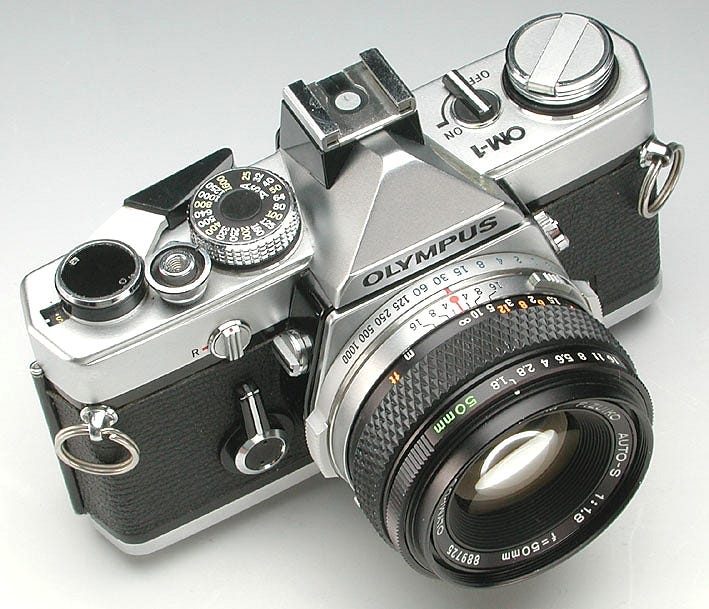
SLRs had a very long reign as a dominant design - from the late 1950s all the way through to the early 2000s - and Digital SLRs are really just an extension of that. DSLRs are only now starting to give way to newer Mirrorless Cameras.
Other formats
Medium format - these are cameras that take larger negatives than 35mm, for example 6cm×4.5cm, 6×6cm, 6×7cm, 6×9cm and panoramic 6×17cm. Medium format cameras come in two types - Twin Lens Reflex (TLR) and Single Lens Reflex (SLR).
Twin lens reflex cameras have two lenses, one for taking the picture and one for you to focus through. There is no mirror involved - examples include the Rollieflex range and the Yashicamat 124G.
Medium format SLRs tend to be top-end devices that command very high prices - such as Hasselblad, Mamiya and Bronica. There is cheaper Russian brand called Kiev that is worth a look if you are on a budget.
So that’s it, if you are shooting on film. You pays your money and you makes your choice. Personally, if you are doing my kind of non-specialist photography, you won’t go far wrong with any SLR but I’d also recommend taking a peek at quality rangefinders - Yashicamat, Olympus and obviously Contax, Leica - or medium format cameras especially.
The latter can be a revelation and boost your photography in all kinds of ways but especially in terms of composition.
I’d be interested to know your thoughts - what film camera choices have you made and why? Let me know in the comments.