


Hemingway was the real deal. I first came across him while studying Spanish. My teacher idolised him, and in fact would have made a great Hemingway character himself. He was a Glaswegian priest who’d started off down the mines and was tough as the proverbial old boots.
He used to joke about Hemingway’s macho image, the gun-toting, hard-drinking, man’s man. But we both knew Hemingway was so much more that.
I quickly gleaned some early insights into the tight, terse style which Hemingway espoused - a template for many 20th-century novels that followed.
I fell in love with the subject matter - I remember being blown away completely by For Whom the Bell Tolls, a story that amplified and echoed my own love of all things Spanish.
It is also to Hemingway that I owe my love of the bullfight, which has lasted to this day. Hemingway understood the bullfight better than anyone, Spanish or Gringo, with all its savagery and uncanny beauty.
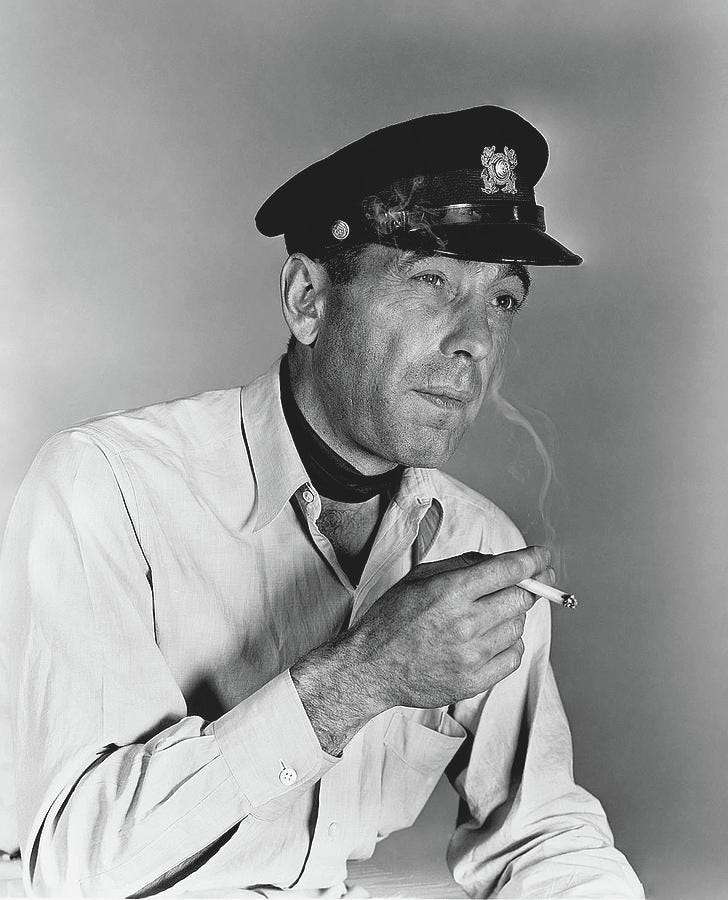
Hemingway’s style is the thing that still fascinates me. I had been studying English Literature so I was very familiar with Thomas Hardy, George Eliot, Dickens and poets such as Tennyson and Wordsworth. These came from a world quite different to that of Hemingway.
He was a voice distinct even from his peers - a true successor to modernists like Joseph Conrad, for example.
Hemingway’s work was concise. Action, silences, not much else. Unlike Conrad, there was very little inner dialogue - but there was passion in bucketloads. Characters could be judged by what they did and through that their motivations became apparent.
He called it the Iceberg Theory - a small amount visible on the surface, with masses of unseen activity going on below.
Hemingway’s style was strongly influenced by the First World War experiences that led to The Sun Also Rises, curiously the one major novel I haven’t yet read.
He felt the war had destroyed the need for flowery phrases and the exposition of inner dialogue. His characters were often hard-boiled, sometimes cynical, often battered by life.
Harry Morgan, the down-at-heel skipper in To Have and Have Not, echoes that perfectly when he says:
I’m playing a machine now that doesn’t give jackpots anymore. Only tonight I just happened to think about it. Usually I don’t think about it.
His style made for prose that was epic, taut and cinematic in its vision. It is no coincidence that many of his greatest stories were to become movies - think of Death in the Afternoon, The Dangerous Summer, To Have and Have Not, The Snows of Kilimanjaro, The Sun Also Rises and, of course, The Old Man and the Sea, with Spencer Tracey. Such a wonderful actor.
Hemingway’s influence can clearly be seen in later Hollywood films that had no connection to him, such as Casablanca, where the world-weary hero displays a cynicism towards everything. Ultimately his actions speak far louder.
He also gave us a global vision. His novels were not set in twee drawing rooms, metropolitan bars and restaurants. They were set in Kenya, Spain, Cuba and Italy, where the landscape often became another character in the narrative. Often, there is a clash between the past and present - particularly in his novels set in Spain.
Hemingway gave us a view of the world that was more befitting the fast, violent, industrial energy that was driving the new century. He also inspired dramatists like Orson Welles, I am pretty sure, who was a great friend of his. Hemingway’s characters also tended to have a real impact on the world one way or another, like Robert Jordan in For Whom the Bell Tolls.
It is fashionable today to see Papa as a bloodthirsty alpha male, with his love of the bullfight, safari shoots and deep-sea fishing.
Personally, I see him as a a hugely empathetic author who depicts human life in all its folly, stupidity, bravery and virtue. It is no surprise he developed an affinity for the paintings of Goya - there is an excellent article on this by John Meyers that is well worth reading.
The connection with Hemingway and Spain will probably be with me until the day I die. Papa is a clear influence on many, many other authors and novels that I love - Joseph Heller’s Catch-22, for example, Catcher in the Rye, To Kill a Mocking Bird and the work of Raymond Chandler, which took the iceberg theory to new levels. Faulkner was a close friend, as was the much under-rated John Dos Pasos and James Mitchener.
Hemingway was a journalist who became a novelist. He inspired me to take up journalism as a career. He nurtured in me a love of Spain that has lasted more than 40 years. He indirectly led me to the love of my life and espoused a philosophy that was both noble and dark, savage and beautiful at the same time.
Yes, in his latter days, he was difficult to be with. There were good reasons for that, which can be understood in this wonderful documentary on his life. But I have always had a soft spot for him, whatever his age. His was the true voice of the 20th century.
If you get a chance to read anything by him, do so. Here’s to you, Papa.