


The contrast between these two movies about the Troubles in Northern Ireland could not be more extreme. Both have something to say about that period, one from the perspective of a little boy. The other from that of a young squaddie, a British soldier, on his first tour of duty.
The Troubles were a period of roughly 40 years when Catholic and Protestants, Nationalists and Unionists, fought each other and the British Army, with bombs, bullets, Aramalite rifles and tit-for-tat killings.
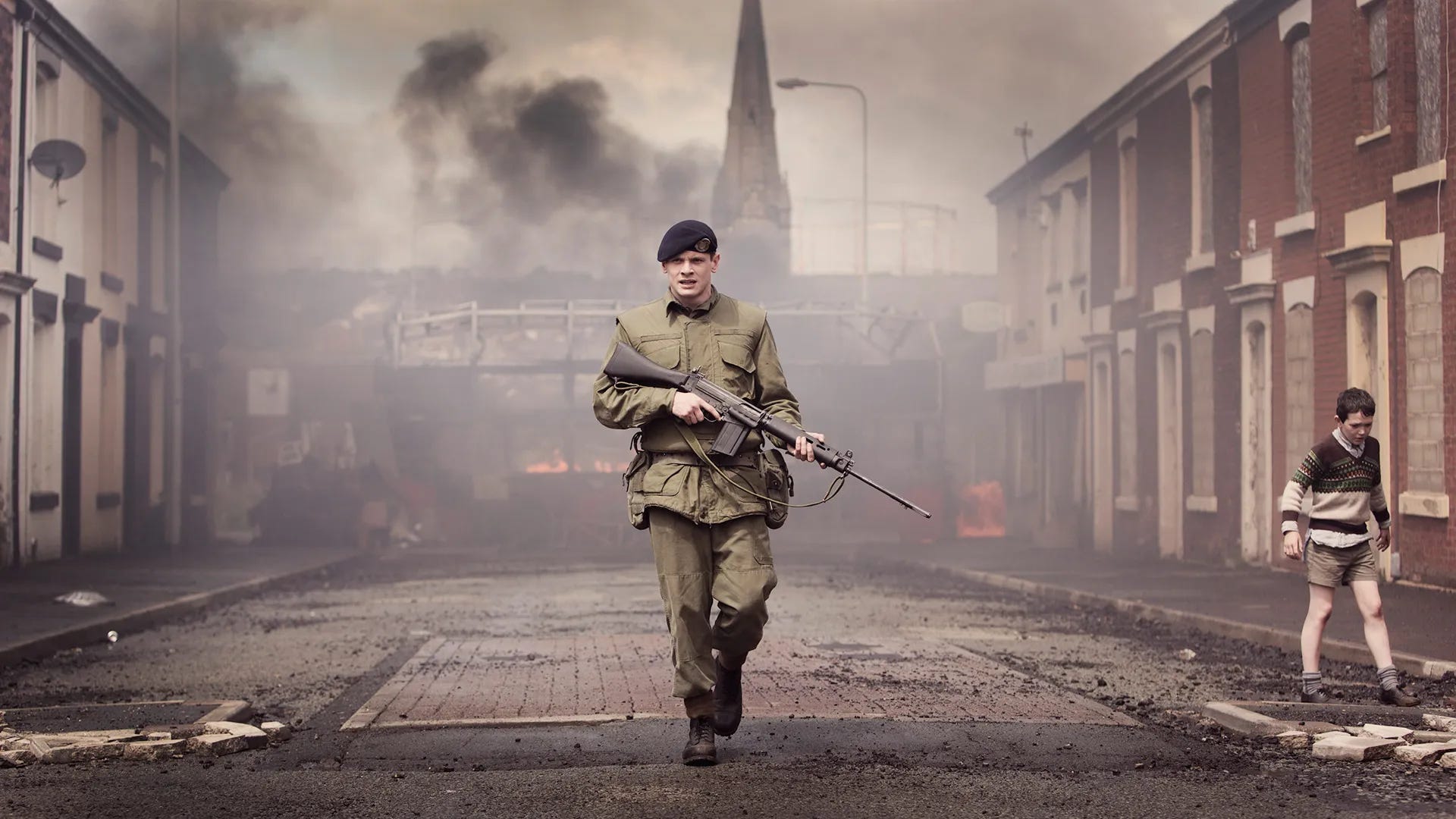
Two of my friends from school joined what was then the Royal Greenjackets immediately from Sixth Form, as Junior Leaders. They served in Northern Ireland at the high point of what was, in all but name, a small-scale, long-running Civil War.
Both ended up deserting within 12 months, serving time in military prison. From what they told me, a tour of duty in Northern Ireland for Squaddies like them was pretty tough and could last over a year at the time. This was later reduced because the wear and tear on the troops was just too much.
Their lives, from what I gather, were often spent in ultra hidden Observation Posts (OPs), pissing in lemonade bottles and living in fear of discovery all the time. They would often find themselves hiding in rooftops or roof spaces, terrified of coming under attack.
Anyway, the reason I bring this up is that I have just watched both movies. ‘71 is told from the British Army’s viewpoint mostly. The other is told from the perspective of a little boy, Kenneth Branagh himself, who grew up there around the same time. They are quite different films and perhaps it is wrong to judge them together. But I am going to do it anyway.
One is filmed in period colour, ‘71. The other is told entirely in black and white and is reminiscent of Roma, directed by the Mexican genius Alfonso Cuarón, but does not come anywhere near its level of artistic achievement, in my view.
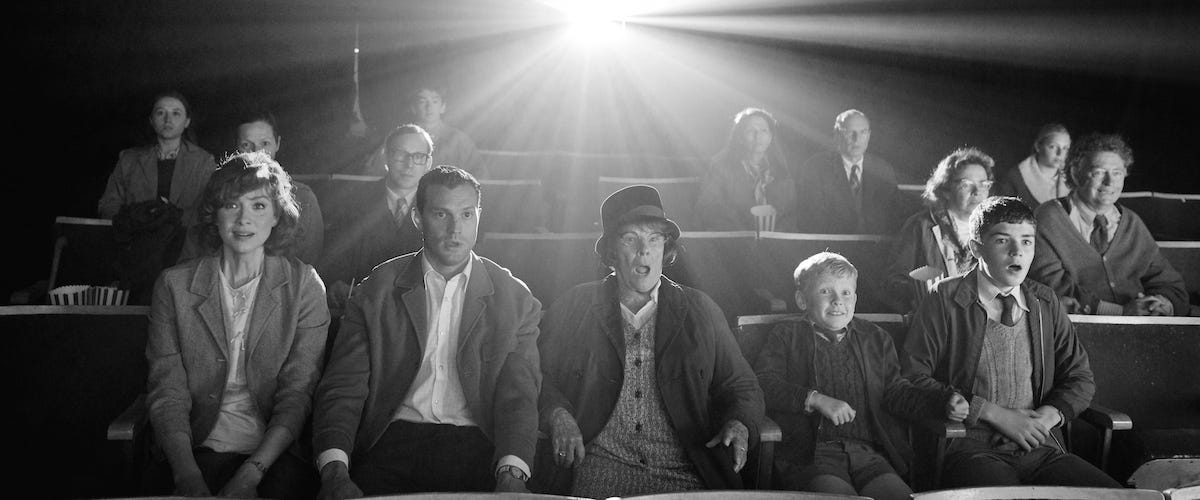
I have a lot of time for Kenneth Branagh. His Shakespeare productions are amazing - I was recently moved to tears watching All is True, a film I wholeheartedly recommend but I wonder whether Belfast takes him out of his comfort zone. The film tries too hard to be authentic in my view. The sets look unreal. The violence looks timid and staged. What might be frightening is not. There is a sense that Branagh was trying to recreate a version of Roma mashed up with Cinema Paradiso. Nostalgic, sentimental but not authentic.
In ‘71, on the other hand, there is a real sense of violent authenticity from the moment the squaddies set down in their improvised barracks.
Sinister intelligence men prowl around the building at night, sporting those 1970s moustaches we all know and love. The colour has the look of my old family slides, Kodachrome or Ektachrome, with dark blacks, sharp greens and rich reds. Everything goes wrong on the platoon’s first patrol and our wide-eyed recruit, a young Jack O’Connell, ends up weaponless and on the run across Catholic and Protestant areas.
I won’t spoil it for anyone who hasn’t seen ‘71, but a high sense of tension permeates the entire movie. Jack O’Connell is the innocent set loose in a world where intelligence men help terrorists make bombs, where children know a thousand ways to escape the police or army and where poverty is grim and desperate.
I can’t recall many films that capture the Troubles in such an authentic manner as this - maybe the TV series Harry’s Game from the 1980s - but I can’t name many more.
So I think that Belfast is a very rare movie - one that Kenneth Branagh did not get quite right. It’s a shame.