


Why did journalists drink so much in what is now the last century? Well, one somewhat cynical response - from Private Eye, I think - was guilt. A bit harsh, in my view. The truth is journalism, especially national newspaper journalism, consisted of much sitting around doing very little. A bit like the police, we worked very long hours and many of them were devoid of interest. Hence, might as well spend some time in the boozer.
Some argue journalism was better when we drank. Inky people like me never had a monopoly on the pubs of Fleet Street and the alleyways around it, yet we behaved as if we owned every boozer within a mile of Ludgate Circus.
A few Fleet Street hostelries, admittedly, were sort of out of bounds, especially around the Royal Courts of Justice, at the west end of Fleet Street. They were not rough and ready in the way that we were - and they were too far to walk to for a break. El Vinos and all that jazz was more for barristers like the fictional Rumpole of the Bailey.
A few other pubs were and remain, more touristy spots which hacks like myself would generally avoid. The Old Cheshire Cheese is one of them. It’s been a fixture since 1666 but has never been a huge attraction for journalists, (apart from Dr Johnson, Samuel Pepys and a few notable others).
I once saw the sublime John Mortimer, creater of Rumpole and Pommeroy’s wine bar, wobbling down Fleet Street from the direction of the Cheese. He looked a little the worse for wear but was fully kitted out in his goldfish bowl glasses, black jacket and striped pants, heading towards the Bailey, which is just down the road.

For most journalists of my era, the Cheese was not a place to go. Too many tourists asking what beers were available, how much was the Guinness and other, what we held to be, ridiculous questions.
I worked casual shifts on the Sun and Mail on Sunday, the streets on any night around Fleet Street were rammed with trucks - either taking newspapers away for distribution or bringing in newsprint to be loaded into the presses.
In Bouverie Street, where the old Sun had its base, the loading of huge rolls of newsprint was memorable. The newsroom was immediately above the presses, so that meant every time a bale was loaded, the whole building shook.
Our favourite watering hole back in those days was The Old Bell, behind St Bride’s Church at the eastern end of Fleet Street. It is still a bog-standard London boozer but it is very close to the historic heart of printing in London.
St Bride’s Church behind it, with its unique tiered spire, was designed by Christopher Wren in the wake of the Great Fire of London in 1666. It is said to be the archetype for every tiered wedding cake, not that we ever mentioned it. It is also the site of Brideswell, a natural water source that dates back to Roman times.
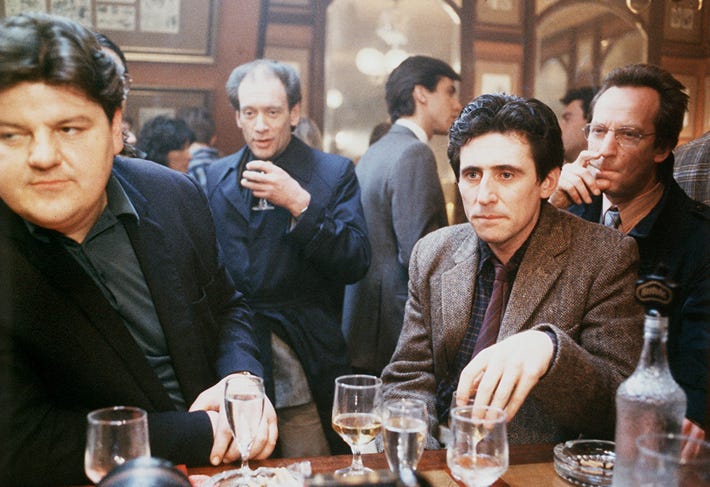
These days, The Bell is past its best but there was a time when it epitomised Fleet Street. It played a leading role in the iconic movie Defence of the Realm (1986), featuring Denholm Elliott, Gabriel Byrne and Greta Scacchi among many other great actors.

The Bell was close by the site of the workshop of Wynkin de Worde, a pioneering printer who set up shop there around 1500. When I worked for the Express, there was a stylish and alluring wine bar of that name on the site, which was immediately underneath the church and a stone’s throw from the pub.
Across Fleet Street there were other temptations on a break. Poppins or the Popinjay was the office pub for the Express crew, immediately under the office as I recall or maybe slightly to the left as you came out. It was a real spit and sawdust joint. Sadly, it closed years ago and became a branch of Boots the Chemist.
On my first day there as a sub-editor I was taken out for lunch with a couple of colleagues. It was admittedly a quiet day and little work to be had.
Three pints in, as the new boy, I was getting a bit worried about the consequences of this debauchery. Just as I expected, the Chief Sub stormed in looking for us. He promptly marched up to the bar and offered us a fatal fourth round. I honestly cannot remember if we actually went back to the office after that.
We also had an informal competition for longest lunch break in history. This was far and away settled by one Daily Star sub-editor, who famously went out for lunch on a Monday and came back a week later.
This was nothing new. In earlier days, journalist and editor Hannen Swaffer was so pissed returning from lunch that he collapsed in front of Lord Northcliffe.
‘Mr Swaffer,’ said his Lordship, ‘there are far too many drunkards working for this newspaper.’
‘Quite right, sir,’ said Swaffer, wobbling to his feet. ‘I’m just on my way to sack a few.’
A features editor I once worked for - now working in the States - used to boast about how he had perfected the art of throwing up from a black cab after a shed-load of lager.
This involved asking the cabby to slow down gently, opening the passenger door, spewing everything out in one graceful manoeuvre, closing the door and inviting the cabby to carry on as of if nothing had happened. Hasn’t had a drink now in decades he assures me. Good thing or he’d be dead.
Other than The Bell, there was also the Old King Lud on Ludgate Circus on a Sunday afternoon. It was another favourite but has long since gone.
Once the Express moved across the bridge to Blackfriars, we were a little stuck for pubs. On Sundays, usually a quiet day, there was always the Rose and Crown in Colombo Street, which used to do free roast spuds and chunks of Cheddar in the afternoon, probably still does.
We also had an upgraded version of Poppins under the swish new offices. We didn’t frequent it much - a dangerous place to play because that was where all the execs filled out their evenings.
I recall a very mouthy Australian sub-editor being sacked by the Daily Star editor on the spot one night in the new Poppins. Can’t recall her name but it was a very drunken rant. This was the point at which drinking in an office environment, which had been unregulated to this point, suddenly became a work event.
In the summer, we would often spend woozey afternoons on the steps outside the Founders Arms on Bankside, just past Blackfriars Bridge and before you get to the Globe Theatre. I recall Page Three girl Jo Guest stopping by with us subs one hot summer’s day. She was a woman with a taste for bottles of Becks and a great sense of humour.
Within ten minutes she had been recognised by the building crew across the road. A couple of them came over with a Jo Guest calendar for her to sign - even we were a bit shocked when they opened it to expose our Jo, fully naked and legs akimbo, for the autograph.
The only other pub worth a mention is the Ye Olde Mitre, dating back to Lizzy the First’s days. It was the haunt of the Daily Mirror in my day, long before their offices got turned into Sainsbury’s head office.
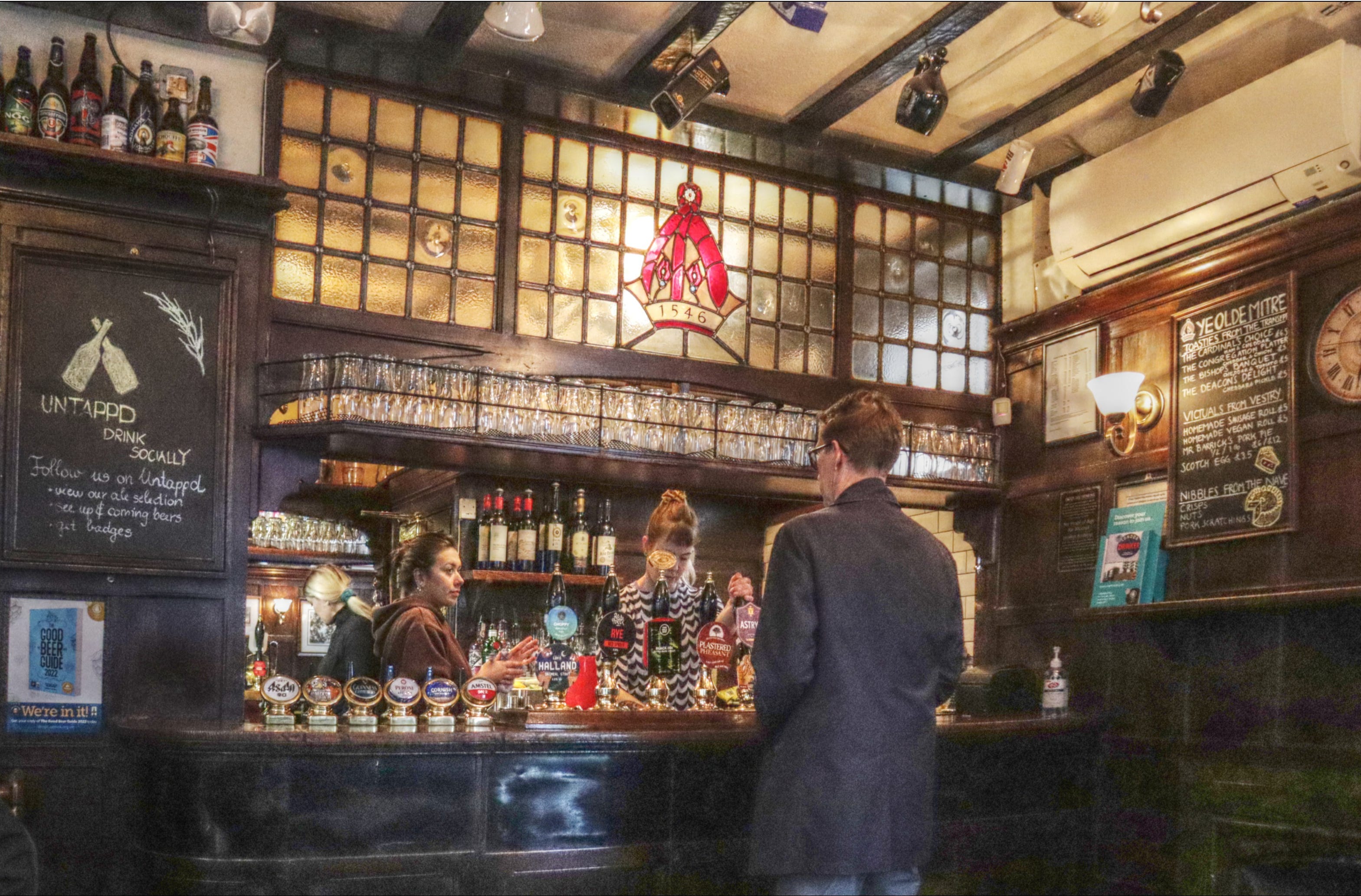
The Mitre is down an alley off Hatton Garden and has a bar with - I think - a cherry tree growing through the middle of it. Nice pub but a bit too far from what I would have called core Fleet Street. It has a long history - that goes back to the 1550s. Queen Elizabeth I is said to have once danced around a cherry tree in its back garden, no doubt in the company of Blackadder.
I really miss the Street of Shame and the life. Salad days, I guess.